What is a data centre? How it works, Tier levels and PUE
In brief
- A data centre rests on four pillars: power, cooling, network and physical security.
- Tiers I to IV (Uptime Institute) describe a site's redundancy, not a promise of uptime.
- "Tier 3+" is a marketing phrase, not an official level, so ask to see the certificate.
- PUE measures energy efficiency, but it ignores water and carbon.
- Before you choose, check location, certifications, redundancy, SLA and DDoS protection.
What is a data centre? It is a secure building that houses servers, storage and network equipment. It powers them around the clock, cools them and connects them to the internet, so that websites, apps and services stay reachable 24 hours a day.
Hosting plans often show "Tier 3+", "PUE" or "ISO 27001" without explaining what those labels guarantee. This article covers how a site works, which indicators matter, what that looks like at Telehouse Paris, and which questions to put to your host.
What is a data centre used for?
A data centre hosts, protects and delivers data and applications: cloud platforms, websites, banks, online games, VPS. A server under a desk goes down at the first power cut or router reboot. In a data centre, electricity, cooling and connectivity are designed never to stop.
That is also why an app running on localhost is not visible from the internet. To be reachable, a service has to run on an exposed machine, with a public IP address and a reliable network.
There are three main families:
- Enterprise data centres are private and serve a single organisation.
- Carrier-neutral colocation data centres rent racks, power and connectivity to many customers, hosting providers included.
- Hyperscale facilities are very large sites run by the big cloud companies.
A hosting provider therefore does not need to own its building. Many rent racks in a colocation site and concentrate on servers, network and support. Those servers are then split into virtual machines, as explained in how a VPS works on top of a physical server.
How does a data centre work?
Four pillars hold everything together: power, cooling, network and physical security. If one fails, the others are of little use.
Power supply: never cut out
A serious site is connected to the grid through two separate feeds. When the mains drop, everything happens within seconds. Battery-backed uninterruptible power supplies (UPS) take over instantly, then diesel generators start from their fuel reserve. The batteries only last a limited time. Telehouse, for example, quotes 30 minutes of battery autonomy when fully charged at its Voltaire site.
Redundancy is expressed as N, N+1 or 2N. Take a load that needs 4 UPS modules:
- N: 4 modules, no margin. One failure and the load drops.
- N+1: 5 modules. One can fail or be serviced without consequence.
- 2N: 8 modules, two complete and independent chains.
Cooling: getting the heat out
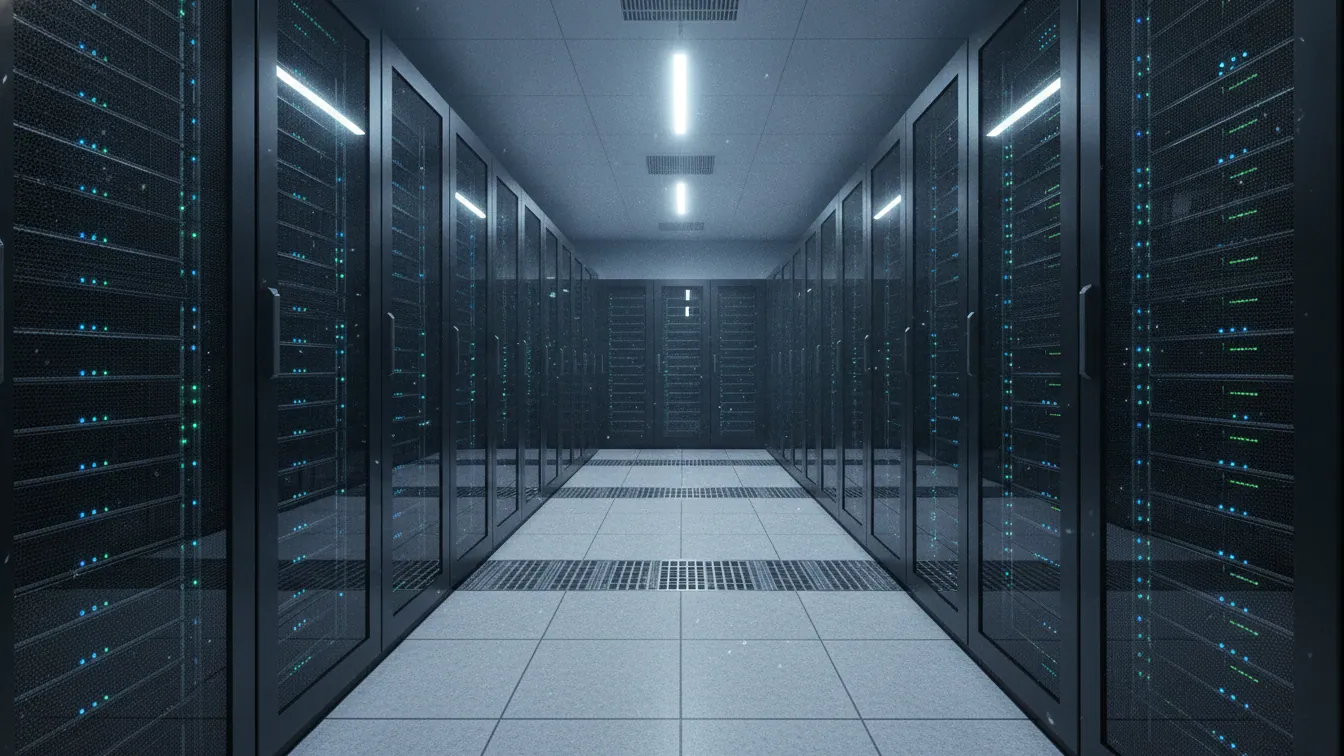
Almost all the electricity a server draws ends up as heat. Server rooms are therefore laid out in cold aisles (cool air enters at the front of the racks) and hot aisles (warm air leaves at the back), contained so the two airflows do not mix. Precision air conditioning units (CRAC/CRAH) produce the cold air, and free cooling uses outside air when the weather allows.
GPU machines for AI change the picture. Their heat density pushes operators towards liquid cooling, applied directly to the components.
Network interconnection and physical security
A carrier-neutral colocation site hosts several telecoms operators. Hosting providers connect there to internet exchange points (IXPs) such as France-IX and announce their routes over multi-homed BGP, meaning through several upstream providers at once. For you, that means lower latency and a network that routes around a failing carrier. If you want to see how fragile routing can be when it goes wrong, read our article on BGP hijacking, real cases and RPKI protection.
On the physical side, expect biometric access control, 24/7 CCTV, fire detection and automatic gas suppression (Telehouse's Voltaire site mentions FM200), which avoids soaking the servers with water.
Tier 1 to Tier 4: what do data centre levels mean?
The Tier classification comes from the Uptime Institute. A Tier III site is "concurrently maintainable": any piece of equipment can be serviced without shutting down the IT load. Tier IV adds fault tolerance. The Uptime Institute is careful to say, however, that a Tier IV is not inherently "better" than a Tier II. Each level answers a different business need.
| Level | Redundancy | Maintenance without downtime | Theoretical availability | Annual downtime |
|---|---|---|---|---|
| Tier I | None | No | 99.671% | ~28.8 hours |
| Tier II | Redundant components | No | 99.741% | ~23 hours |
| Tier III | Multiple distribution paths | Yes | 99.982% | ~1.6 hours |
| Tier IV | Isolated, fault-tolerant systems | Yes | 99.995% | ~26 minutes |
These percentages are commonly quoted theoretical values, not a contractual commitment. What actually protects you is the SLA in your contract. For a view of providers based on measured results rather than brochures, our VPS comparison with fio, sysbench and iperf3 benchmarks is a useful companion.
In plain terms: "Tier 3+" does not officially exist. The Uptime Institute defines four levels only. "Tier 3+" is a marketing phrase, usually a Tier III design with some extra redundancy. That is not necessarily false, but you cannot verify it without a document.
Also ask what the certification covers: the design (Design Documents), the finished building (Constructed Facility) or the running of the site (Operational Sustainability). A site can be well designed and badly operated. EN 50600 and TIA-942 exist as alternative standards.
PUE: measuring a data centre's energy efficiency
PUE (Power Usage Effectiveness) is calculated like this:
PUE = total facility energy / IT equipment energy
At 1.0, every watt would go to the servers and none to cooling or losses, which is the theoretical ideal. Industry surveys such as the Uptime Institute's 2026 survey track these indicators over time. The closer PUE gets to 1.0, the less energy is lost to cooling and electrical losses.
PUE has limits. It says nothing about water use (the WUE indicator) or carbon emissions (CUE). A site at 1.2 running on carbon-heavy electricity is not necessarily cleaner than a site at 1.4 running on low-carbon power.
Regulation depends on where the site stands. A facility in the EU, such as one near Paris, falls under the EU Energy Efficiency Directive: operators whose data centres have a total rated energy input of more than 500 kW must report their energy indicators every year. That is Article 12 of Directive (EU) 2023/1791, and Delegated Regulation (EU) 2024/1364 sets the reporting framework. In the UK, the approach is different: since September 2024, data centres have been designated critical national infrastructure, which means operators can expect more government support in preparing for and recovering from serious incidents.
Why do these sites use so much energy? The servers run continuously, their heat has to be removed, and manufacturing the equipment adds to the overall footprint.
A real example: the Telehouse Paris data centre
Telehouse is a carrier-neutral colocation operator based in the Paris region. OmegaCloud hosts its VPS and dedicated servers there. The Paris Voltaire page lists ISO 9001, ISO/IEC 27001 (information security management) and ISO 14001 certifications, and presents Voltaire as the home of France-IX. The information available does not show whether these certifications cover every Telehouse Paris site, so ask which exact building is concerned and request the matching certificate.
As for the tier, OmegaCloud states Tier 3+. Read that in light of the explanation above: it is a commercial description, and the certificate remains the right proof to ask for.
In practical terms, this is what it means for a customer:
- a secure, professionally run site in France;
- a 10 Gbit/s network with multi-homed BGP and France-IX peering;
- an announced average latency of 12 ms;
- data hosted in France, which is useful for data protection compliance.
What should you check about your host's data centre?
Seven points are enough to tell a solid site from a marketing page.
- Exact location: country, city and the name of the site. For data protection, check that the country is covered by UK adequacy regulations. The ICO confirms that all countries in the European Economic Area have full adequacy, which includes France.
- Tier level and type of certification: design, construction or operation, with the certificate.
- Certifications: ISO 27001 and, depending on your activity, Cyber Essentials or, for health data, the NHS Data Security and Protection Toolkit.
- Power and network redundancy: N+1 or 2N, several carriers.
- A published PUE, not just a "green data centre" label.
- Anti-DDoS protection and its real filtering capacity.
- A contractual SLA and the penalties if it is missed.
At OmegaCloud, 1 Tbit/s Anti-DDoS protection is included in every plan, and the SLA is 99.99%. The details are on the hosting offers pages of the OmegaCloud site.
Frequently asked questions
Is it "data centre" or "data center"?
In British English the standard spelling is "data centre". "Data center" is the US spelling, and "datacentre" as one word is also common. All three refer to the same type of site, so use whichever your organisation prefers and stay consistent.
What is the difference between a Tier 3 and a Tier 4 data centre?
A Tier III site allows maintenance without interrupting operations. A Tier IV goes further: several independent, isolated systems make it fault tolerant. Theoretical availability rises from about 99.982% to 99.995%.
What is a good PUE for a data centre?
The closer it gets to 1.0, the more energy goes to the servers rather than to the rest of the site. Keep in mind that PUE ignores water and carbon.
Does a hosting provider have to own its own data centre?
No. Many providers rent racks in a carrier-neutral colocation data centre. What matters is the quality of the chosen site and transparency about its name, certifications and level of redundancy.
What certification level does the Telehouse Paris data centre have?
Telehouse lists ISO 9001, ISO/IEC 27001 and ISO 14001 certifications for its Paris sites. OmegaCloud states Tier 3+, which is not an official Uptime Institute level. For an exact answer, ask for the Tier certificate of the building concerned and its scope (design, construction or operation).
Why do data centres use so much energy?
Servers run constantly and give off heat that has to be removed. Cooling, UPS systems and distribution losses add to the consumption of the IT equipment itself. PUE exists precisely to measure that extra share.
How do you choose from here?
Take the checklist above and send the seven questions to OmegaCloud's support team. The precision of the answers will tell you a lot.
If you are looking for a Linux VPS, a Windows VPS or a dedicated server hosted at Telehouse Paris, with 1 Tbit/s Anti-DDoS included, a 99.99% SLA, data in France and human support 24/7, browse the hosting offers on the OmegaCloud site. In the interest of transparency, these offers are currently available for pre-order only, with availability announced for 1 November 2026.